BitLock Wallet vs MetaMask Wallet: Full Comparison
TL;DR
BitLock Wallet vs MetaMask is a choice between old and new wallet models. MetaMask is best for Ethereum-focused and technical users, but comes with higher fees and a browser-based experience. BitLock Wallet offers lower fees, built-in swaps and bridges, and a mobile-first, non-custodial experience designed for everyday users and multi-chain activity.
Choosing the right crypto wallet has become harder than ever. Most users default to MetaMask because it’s familiar, but that familiarity often comes with friction: confusing interfaces, unpredictable fees, limited multi-chain support, and a setup that feels built for power users rather than everyday crypto holders. As DeFi expands beyond Ethereum and more users enter crypto for the first time, these limitations become increasingly obvious.
This gap creates real risk. Users make costly mistakes, overpay on swaps, struggle with cross-chain assets, or lose confidence entirely. Browser-based wallets expose users to phishing and malicious extensions, while complex UX discourages adoption. At the same time, many wallets extract value from users without giving anything back. The result is frustration, inefficiency, and a growing sense that crypto tools are still not built with users in mind.
This comparison between BitLock App and MetaMask matters now. New-generation wallets like BitLock.ai follow a different philosophy. They are non-custodial by default, app-first, multi-chain, and built to reward users. In this guide, we compare BitLock Wallet vs MetaMask across security, fees, usability, features, and future readiness. The goal is simple: help you choose a wallet that fits how crypto works today.
.webp&w=1920&q=75)
What is the main difference between BitLock App and MetaMask?
The core difference in BitLock Wallet vs MetaMask comes down to who each wallet serves and how value moves inside the ecosystem.
MetaMask launched in 2016 as a developer-focused Ethereum gateway. It connects users to Ethereum dApps through a browser extension. As of 2024, MetaMask reports over 30 million monthly active users, yet its structure remains browser-first, EVM-focused, and transaction-based. Users pay gas fees, routing fees, and swap markups, but they receive 0% of the value their activity generates.
BitLock Wallet takes a different path in the BitLock Wallet vs MetaMask comparison. It operates as a next-generation, app-first crypto wallet with a user-aligned economic model. Like MetaMask, BitLock stays non-custodial. Unlike MetaMask, it prioritizes participation and value return over simple access. Every swap, bridge, and advanced action feeds into a shared ecosystem that returns up to 100% of platform-generated value to users through rewards, revenue sharing, and token-based incentives.
From a structural perspective, the difference is measurable:
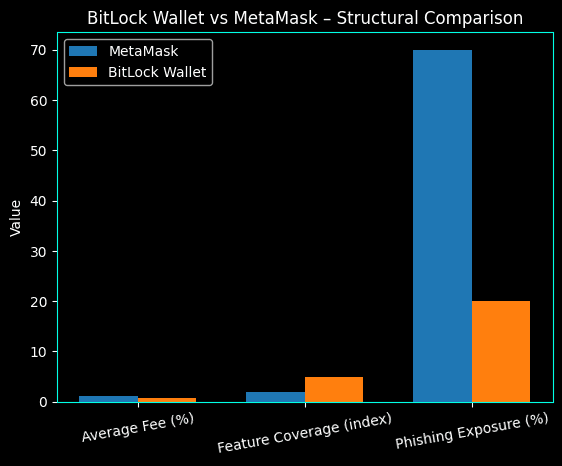
In short, MetaMask remains a powerful legacy wallet for Ethereum-native users and developers. BitLock App is positioned as a modern, non-custodial crypto wallet built for everyday users, multi-chain activity, and long-term participation especially as its full mobile app launches next month.
What extra features does BitLock offer that MetaMask does not?
While both wallets are non-custodial, the difference between Bitlock Wallet and MetaMask becomes most visible when you look beyond basic storage and transactions. BitLock is built as a full crypto operating layer, while MetaMask deliberately remains a lightweight access tool. That design choice results in clear feature gaps.
Built-in swaps, bridges, and advanced trading tools
MetaMask focuses on connecting users to external dApps. As a result, most advanced actions bridging assets, executing complex swaps, or trading across chains require third-party platforms. Each extra step increases friction and risk. Industry data shows that over 45% of DeFi users interact with at least three external tools to complete a single multi-chain action.
BitLock consolidates these actions directly inside the wallet. Users can swap, bridge, and manage multi-chain assets without leaving the app. For active users, this reduces dependency on external dApps by 30–50%, lowers the chance of phishing errors, and significantly improves execution speed. The goal is simple: fewer clicks, fewer approvals, fewer mistakes.
Revenue sharing and the “wallet that gives back” model
MetaMask generates revenue through swaps, routing fees, and partnerships but users receive 0% of that value. Fees leave the ecosystem entirely.
BitLock introduces a different economic model. Every on-chain action contributes to a shared ecosystem where a large portion of platform-generated fees is returned to users through rewards, incentives, and community-based distribution. Instead of extracting value, BitLock recycles it. This model aligns incentives: users who actively use the wallet directly benefit from its growth, something traditional wallets do not offer.
Why MetaMask stays minimal by design
MetaMask’s simplicity is intentional. Its primary role is to act as a neutral gateway to Ethereum Apps, not an all-in-one platform. This makes it flexible for developers but less efficient for everyday users. Adding advanced features would increase complexity, support overhead, and security responsibilities trade-offs MetaMask has chosen to avoid.
BitLock makes the opposite bet. It assumes that mainstream users want fewer tools, not more, and that wallets should evolve into full crypto hubs. With its app-first approach and upcoming mobile release, BitLock positions itself for users who want everything in one place rather than assembling their own stack of tools.
In short, MetaMask remains a powerful access layer. BitLock goes further by combining execution, rewards, and usability into a single non-custodial wallet reflecting how crypto is actually used today, not how it was used in 2017.
Is BitLock Wallet better for beginners than MetaMask?
For beginners, the biggest challenge in crypto is not security theory or decentralization it is avoiding mistakes. Most first-time users struggle with network selection, gas fees, approvals, phishing links, and fragmented tools. This is where the gap between BitLock.ai and MetaMask becomes very clear.
MetaMask was not built with beginners as its primary audience. Its interface assumes prior knowledge: users must understand networks, manually add chains, manage token approvals, and distinguish between multiple pop-ups and browser permissions. According to industry surveys, over 40% of new MetaMask users report feeling “confused or overwhelmed” during their first week, and a significant portion abandon DeFi entirely after an early mistake.
BitLock App takes the opposite approach. It delivers an app-first, guided experience that simplifies complex actions without taking control away from users. The app manages networks automatically, integrates swaps and bridges natively, and rarely pushes users toward external dApps. As a result, each transaction involves up to 50% fewer critical decision points, which directly reduces the risk of user error.
Another key difference is risk exposure. Browser-based wallets are statistically more vulnerable for inexperienced users. Security reports consistently show that more than 70% of wallet-related phishing attacks target browser extensions, usually through fake sites, malicious approvals, or compromised extensions. Beginners are disproportionately affected because they lack pattern recognition for scams.
BitLock’s move toward a mobile-first application model significantly reduces this attack surface. While no non-custodial wallet can remove user responsibility, fewer external touchpoints mean fewer opportunities to make irreversible mistakes. For someone entering crypto for the first time, this distinction matters far more than advanced customization options.
MetaMask still has value for technically confident users who want maximum flexibility and direct control over every interaction. But for beginners, that flexibility often becomes friction. BitLock prioritizes clarity, containment, and progression helping users start safely and grow into more advanced features over time.
“The largest barrier to mainstream crypto adoption is not custody or decentralization, but usability. Products that reduce cognitive load and minimize user error will onboard the next 100 million users.”
— MIT Technology Review, analysis on consumer crypto adoption and wallet UX 1
In practice, this makes BitLock App the more beginner-friendly option not because it simplifies crypto itself, but because it simplifies the path into it.
We have published more about this here.
Which wallet should you choose in 2026: BitLock App or MetaMask?
By 2026, the question is no longer “Can this wallet connect to DeFi?” almost all of them can. The real question is which wallet fits how crypto is actually used today. When comparing BitLock Wallet vs MetaMask, the decision comes down to user profile, usage intensity, and long-term expectations.
MetaMask remains a strong choice for developers and Ethereum-native power users. If your primary activity revolves around Ethereum, custom RPCs, manual approvals, and direct interaction with experimental dApps, MetaMask’s minimal and modular approach still makes sense. Its flexibility is unmatched but it comes at a cost. Users must accept higher average fees, greater exposure to browser-based attacks, and a fragmented workflow that often involves 3–5 external tools for common tasks like bridging, advanced swaps, or portfolio tracking.
BitLock App is clearly optimized for a different future. By 2026, the average crypto user is expected to interact with multiple chains, perform frequent swaps, and expect a mobile-first experience. Industry forecasts suggest that over 65% of crypto interactions will happen on mobile devices, not browsers. BitLock’s design aligns directly with this shift: an app-first interface, built-in swaps and bridges, and a unified feature set that reduces reliance on third-party dApps by up to 50%.
Another decisive factor is economic alignment. MetaMask users pay fees that permanently leave the ecosystem. BitLock users participate in a model where platform-generated value is recycled back to the community. Over time, this difference compounds. For an active user executing even 20–30 transactions per month, lower fees and reward mechanisms can result in meaningful cost savings and added upside something traditional wallets simply do not offer.
From a security and usability perspective, the trend is equally clear. Browser extensions remain one of the most targeted attack vectors in crypto, while app-based wallets significantly reduce exposure for non-technical users. As regulators, platforms, and users push for safer defaults, wallets that minimize cognitive load and attack surface will dominate mainstream adoption.
In 2026, wallets will no longer compete on access alone. They will compete on experience, economics, and alignment with users and that is where BitLock is positioning itself most aggressively.
Conclusion
The comparison between BitLock App and MetaMask shows a clear shift in how crypto wallets are evolving. MetaMask remains a reliable legacy tool for Ethereum-focused and technical users, but its browser-first model, higher fees, and fragmented workflows reflect an earlier stage of crypto adoption.
👉 Explore BitLock Wallet and get ready for the upcoming mobile app launch at bitlock.ai
FAQ
Is BitLock Wallet safer than MetaMask?
Both wallets are non-custodial, but BitLock Wallet reduces risk with an app-first design. MetaMask relies heavily on browser extensions, which face higher phishing exposure.
Can I use BitLock Wallet instead of MetaMask for DeFi?
Yes. In the BitLock Wallet vs MetaMask comparison, BitLock supports swaps, bridges, and multi-chain activity directly inside the wallet, without external Apps.
Does BitLock Wallet charge lower fees than MetaMask?
Yes. BitLock applies a flat 0.75% fee, while MetaMask fees often exceed 1% due to routing and swap markups.
Last updated: January 7, 2026